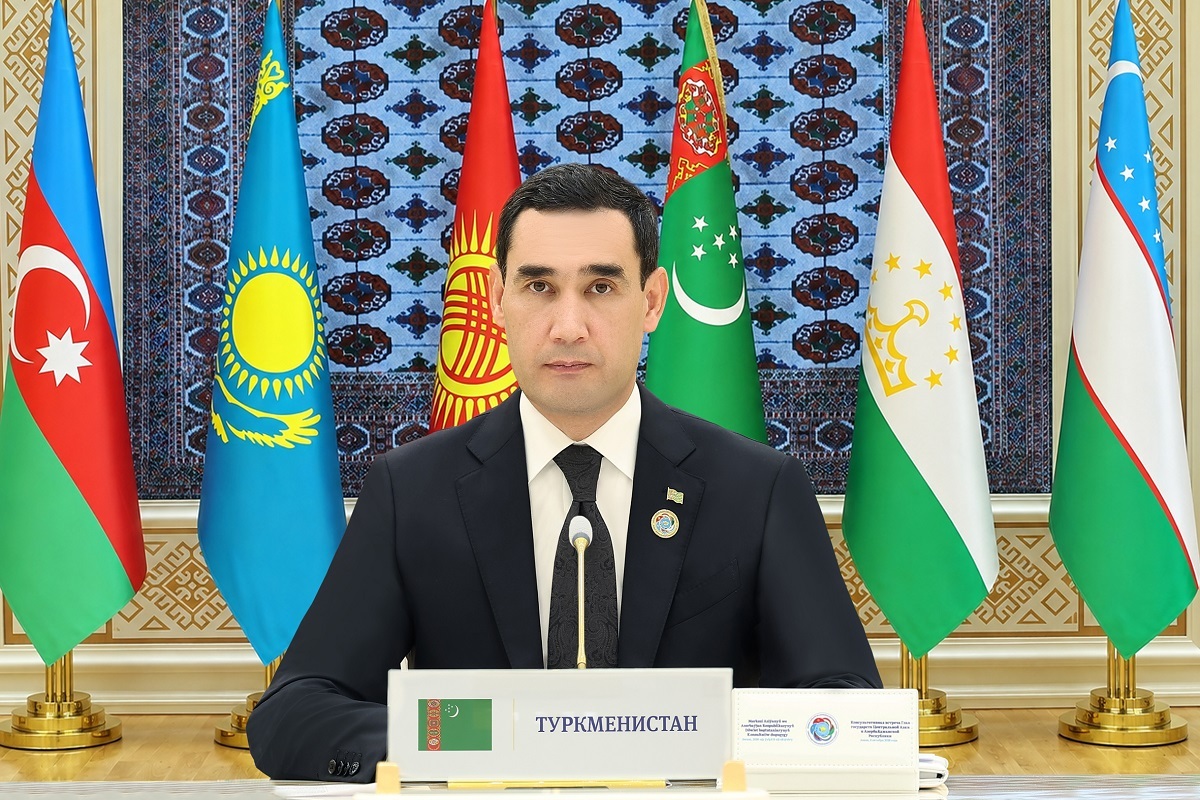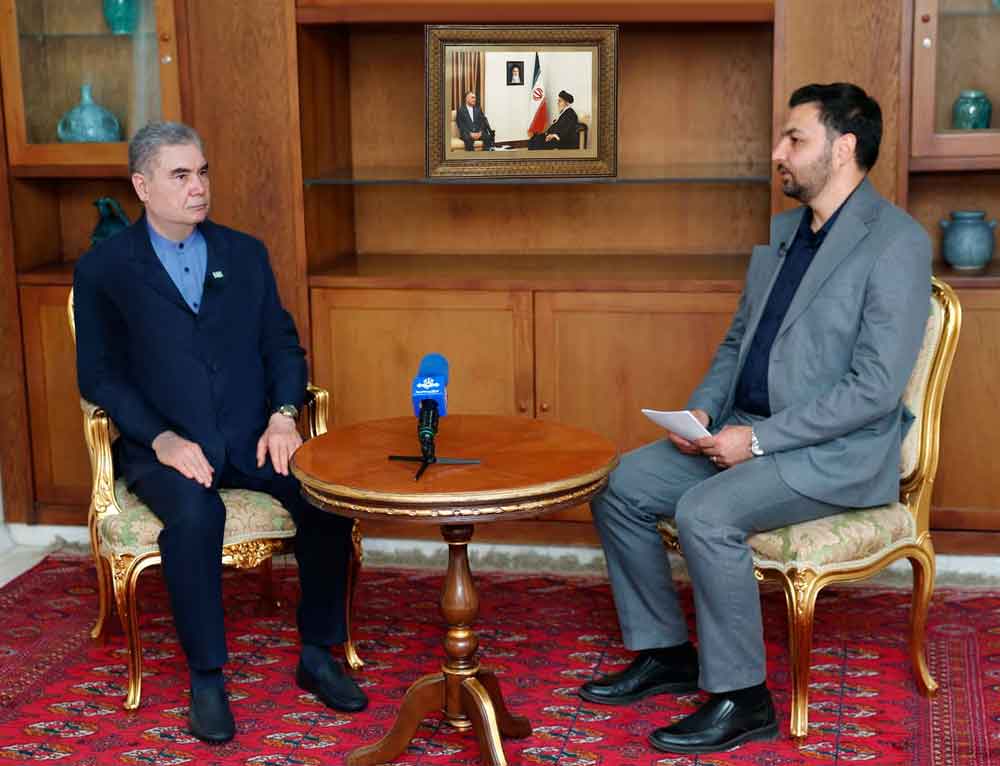
The National Leader of the Turkmen people, Chairman of the Halk Maslahaty of Turkmenistan Hero-Arkadag, within the framework of his visit to the Islamic Republic of Iran, at the request of the Iranian side, answered the questions of the journalist of the Islamic Republic of Iran Broadcasting (IRIB) Seyyed Mohsen Hosseini.
This is another testament to the consistent development of Turkmen-Iranian relations based on the principles of good neighborliness and mutual respect, and the commonality of spiritual and cultural values of the two peoples.
– Honorable National Leader of the Turkmen people, we are glad to see you on Iranian soil! Your support and sympathy for the Iranians at such a difficult moment are important for our people and state, and the Iranian side is grateful to you for this. Iran and Turkmenistan are neighbors and brotherly states. Could you, at the beginning of the conversation, share your memories of your meetings with the now deceased Spiritual Leader of the Islamic Republic of Iran and talk about their significance?
– Thank you very much! From time immemorial, the Turkmen people have cherished the bonds of friendship and brotherhood. Turkmenistan and Iran are neighboring brotherly countries that maintain good and respectful relations.
As you noted, the late Ayatollah Seyyed Ali Hosseini Khamenei was an outstanding personality, recognized not only in his homeland but also far beyond its borders.
Our first meeting with Ayatollah Khamenei took place in the spring of 1998, when we came on a visit to the brotherly country. At that time, I was working as the Minister of Health and Medical Industry of Turkmenistan, and that meeting made a great impression on me. Since then, 28 years have already passed. In 2001, I became the Deputy Chairman of the Cabinet of Ministers for education, science, health care, and culture. And from 2007, for 15 years, I served my people and the Motherland as the head of the Turkmen state.
In 2022, the people elected me as the National Leader of the Turkmen people, Chairman of the Halk Maslahaty of Turkmenistan. And in all state positions, I had the opportunity to meet with the Spiritual Leader of Iran.
At each of our meetings, Ayatollah Seyyed Ali Khamenei invariably captivated with his kindness and high education; being a wise and perceptive person, he gave a lot of valuable advice.
The Turkmen and Iranian peoples have an ancestral custom: to honor elders and show respect to the youth. Therefore, he always shared his thoughts on politics, trade and economic relations, as well as on issues in the cultural and humanitarian sphere that brings peoples closer together. These meetings, held in the interests of the two peoples who maintain anciently established strong bonds, yielded significant results.
Acquaintance and communication with the Spiritual Leader over many years served solely for the benefit of our countries.
– You shared your memories of the Spiritual Leader. Could you dwell in more detail on the most vivid moments that you particularly remember?
– All our meetings were memorable in their own way. But every time we met, the Spiritual Leader, drawing on the wisdom that "On Judgment Day, a neighbor is a help," would say: "For us, you are not just neighbors, but blood brothers."
In my opinion, all our conversations were very important. If we talk about politics, we often held conversations about peace and well-being not only of the two countries, but also of the region and the whole world. As you know, Turkmenistan is the only state in the world whose neutral status has been recognized by the UN three times. That is exactly why we frequently exchanged views on issues of maintaining peace and sustainable development.
He gave many valuable instructions on trade and economic relations. The Turkmen and Iranian peoples, and indeed in Islam as a whole, have an understanding: if a person wants to live life with dignity, he must definitely lay roads and build bridges.
Speaking of this, it is worth noting that over the past years, Turkmenistan and Iran have jointly built quite a few highways, railways, and bridges. As the Spiritual Leader said: "The whole essence of this noble activity lies in ensuring that peoples can maintain connection with each other." In my opinion, this is one of the deepest and most memorable moments of our communication.
In today's conversation, it is impossible to encompass the entire scale of the life path of this outstanding man. He did incredibly much for his people and their well-being. Indeed, the construction of bridges and roads serves to strengthen the bonds of friendship and brotherhood.
With the Spiritual Leader, we often exchanged views on trade and economic ties that go back centuries, as well as on our common historical and cultural roots. We, of course, also discussed issues of raising the younger generation. Based on this, we maintain ties with Iranian scientists, poets, and prose writers. The Institute of Manuscripts operates in Turkmenistan. In this context, we spoke about the importance of studying our common heritage—this is of immense significance for us. As you know, today more than three million Turkmens live in the Iranian province of Golestan. In connection with this, the Spiritual Leader and I often exchanged views on how to further strengthen friendship and brotherhood between our peoples.
Our world-famous poet and thinker Magtymguly rests in Iran. And our people have the opportunity to make a pilgrimage to his burial place. Together we honor his memory and cherish his poetic work. There are very many examples like that.
As I have already mentioned, during the 15 years of my leadership of Turkmenistan, many projects were implemented: the laying of gas pipelines and power transmission lines, the construction of railways and highways. During the period of joint work, the trade turnover per year exceeded 5 billion dollars, and every year it invariably demonstrated a growth of no less than 115, 150 percent. Iran borders other states as well, but the longest border is precisely with our country. The border between Turkmenistan and Iran exceeds 1500 kilometers. The Spiritual Leader always emphasized: "Our border is a border of friendship and brotherhood." This testifies to what an outstanding personality he was.
– The fact that the Turkmen people treat our Spiritual Leader with immense reverence and remember him is a great honor for us.
– The Turkmen people have always treated the Spiritual Leader with the deepest respect. His instructions and wise advice were very valuable to us. At our meetings, we discussed literally all issues related to human life—from birth itself to advanced age.
Of course, we touched upon questions about religion as well. You know that Turkmenistan is a secular, democratic state, but at the same time we deeply revere our faith, our ancestral traditions and spiritual values, and Muslim traditions in general. In this matter, the instructions of the Spiritual Leader are of great importance, especially for the youth. By the way, the Embassy of Iran in Turkmenistan is located next to the Agricultural University. In connection with this, the Spiritual Leader said: "The Embassy staff tell me what well-mannered students you have: the young men are in traditional tahyas (skullcaps), the girls are with two braids. This is the result of your adherence to your ancestral traditions and customs, to the path you have chosen." Of course, I want to emphasize particularly that in this matter—in raising the younger generation—a huge role is played by both our national culture and our spiritual, Muslim traditions.
At our last meeting, the Spiritual Leader asked me: "Brother, are you building a mosque and a madrasah?" And he explained his thought himself: "A mosque is the house of Allah, but building a madrasah is an even more significant matter." He placed a special emphasis on the fact that the erection of a madrasah is a good deed that opens a person's path to true spiritual wisdom.
At that same time, he said: "Brother, because of work, I almost never leave the house. But when you finish building the mosque, I really want to visit there." All these moments confirm once again how deeply thinking a person he was, with an incredibly broad outlook. After all, combining political and economic activity with humanitarian, cultural, and religious activity is a colossal labor. As I have already said, it is customary for us to honor elders and show respect to the youth, and every meeting with the Spiritual Leader left an indelible mark on my soul. That is precisely why the Turkmen people treat him with such immense respect.
– Here is a photograph from one of your meetings with the Spiritual Leader. What do you feel looking at it?
– If I am not mistaken, this photograph is from our last meeting. I was filled with a sense of joy back then from how fruitful our communication was, how sincere our friendship and brotherhood are.
But each of us has our own earthly path, predestined by the Almighty.
We will offer prayers so that the Almighty may grant eternal peace to the soul of the Spiritual Leader of Iran, so that his abode becomes paradise.
– As you know, recently quite a few complex situations have been arising in the world. Thoughtful steps are required to prevent such phenomena. What, National Leader of the Turkmen people, is your position and the position of the Turkmen people on this issue?
– As I mentioned above, there is an expression: "On Judgment Day, a neighbor is a help." Answering your question specifically, I will say: in these complex situations, we kept our borders open and sent humanitarian aid. We did not stand aside. We pursue an "open door" policy. Turkmenistan, following the principles of balance, equality, well-being, and peace, is a country that has received recognition of its neutrality status three times. And therefore, the head of your state, just like your people, is certainly well aware of the fair, peace-loving policy we are conducting today.
Summarizing the answer to your question, I would like to note this: there are no winners in war. After all, a fired bullet does not choose a target—whether it is a child in front of it or a soldier, there is no difference for it. That is precisely why, in political terms, the Turkmen people declare their position everywhere.
– Upon further mention of the name of the Spiritual Leader of the Islamic Republic of Iran, the late Ayatollah Seyyed Ali Hosseini Khamenei, what would you say?
– I will answer in one phrase: his cause continues.
– Honorable National Leader of the Turkmen people, we are grateful to you for expressing condolences to the Iranian people at such a difficult moment, sharing our grief with us, and also for your answers to the questions.
– Thank you!